Saturday, November 18, 2023

The God Delusion - Dawkins


The GOD Delusion is Ironic

Richard Dawkin's latest book, "The GOD Delusion" is a must read for everyone. Theist or Atheist, believer or non-believer, Dawkin's has, for the first time, placed the complete set of arguments about the existence (or non-existence as he would prefer) of God, into a single place for easy reference during after dinner conversation.  Not withstanding his relentless negative and somewhat emotional attacks on the believer, his arguments and counter arguments are well written and within easy grasp of all.  If you can read this book and maintain your own level minded perspective you will be in strong possession of significant knowledge to either impress your dinner guests or perhaps upset them to the point of keeping them from ever coming to your house again -- if that is your wish.  In the end, based on the comprehensive research he has provided, either perspective can still be argued, although he has clearly stated that he is trying to convert believers to his side -- but he has missed the best and perhaps newest argument due to a lack of evidence.   

Most of his arguments are old, 19th century as he has been accused, but never quite understood why.  And most contemporary believers have reconciled their faith with the natural science of the day.  However, he has one new intriguing thread with regard to the origin of religion and he pulls on it, but he freely admits it is arguably one of perhaps many threads that could have caused the human brain to develop religious beliefs as a bi-product of selecting for other things pertinent to survival, or whatever was deemed important during the selection process. And this thread bumps up against something far more important than religion -- It cries forth with the question of human consciousness and it's evolutionary development -- a.k.a. Julian Jaynes.  Alas Dawkins never crosses fully into the pursuit of consciousness and it's potential origins leaving us to wonder if Jaynes was a genius or a quack -- I wonder why?  If you prove consciousness is an illusion than absolutely you have proven there is no God.  He has unfortunately shied away from this subject.  It is the substance necessary to create not just artificial life but artificial intelligence.  A subject he never addresses -- although he poignantly relays the tragic end to Alan Turing, the father of AI, for a completely different reason.

More important to his writings, however,  is his insistence that it is the believer who is suffering from a the delusion, when it is just as clear that he suffers from some sort of emotional discontinuity, perhaps paranoia, that propels his own delusions about what is and what is not true religious faith. So here Dawkin's labors away, trifling with the Almighty, a personal God or natural selection -- no one should really care since both belief in the Almighty or the processes of natural selection are far stronger than Richard Dawkins.  Regardless of what they may believe during the good times, during the dark of night, or on their death bed, does not change the fact that the universe is really really big, perhaps infinite, and that he is far from unlocking the secrets -- something he freely admits in the end.  The secrets that he hopes to find, keep slipping through his fingers as the universe keeps expanding and the smallest building blocks of matter keep turning back into something that he cannot quite grasp. Yet the curiosity of science propels he forward in is quest -- with such conviction to know or finally know, that there is no God.  This is clearly a crusade of sorts for Dawkin's, yet he maintains that he is an atheist.  Somewhere in Chapter 2 though he rates himself a level 6 agnostic -- allowing for a very very small possibility that there actually is a God.  Or else he couldn't continue his quest, it wouldn't make logical sense.  So he too, is deluding himself.  By allowing himself a brief, if not unconsciously repressed uncertainty, about the meaning of life enables him to go on his atheistic crusade -- mimicking all of the same characteristics of religion that he so soundly criticizes.  This is his first state of irony.

Second, if social behavior including morals and values actually evolved as he suggests, including religion, then these things are hard wired into our physiology.  They are firmware, not software, which makes them real.  And no matter what delusion he thinks believers are suffering from -- he goes to quite some extent to explain why these actions are real and necessary -- believers, therefore, are not suffering from anything false.  They do what they do because they are supposed to.  They are behaving as their creator, designer, or natural selector would have them behave...hence reality, no matter whose side you are on.  So twice Dawkin's delusion has taken an ironic twist -- which is truly ironic.  And this makes for the best kind of after dinner conversation.

Dawkins most significant contribution to society, though this particular book, however has nothing at all to do with God or religion.  It has to do with the abuse of young minds.  His stance should be every parents stance and the brainwashing of young minds throughout history is indeed an affront to humanity.  Religion, no religion, God, or no God, we do not have the right to lie to our children in ways that would torment or terrorize their thoughts.  Particularly in ways that would fundamentally alter the way they brains are developing -- at least before the age of eight or nine.  To do otherwise would be the same as altering their bodies physically for instance, the heinous binding of a young girls feet in China.  Dawkin's carries this topic quite well -- but I'm not sure why it's in this particular book.

So in the end, Dawkins has given us a good book -- but has only raised more questions upon which the reader is still left to answer on his or her own -- science gives Dawkins his meaning of life, not humanity in general...and this is ironic.


Tomorrow's Air Force - Smith

 When Tom Cruise as “Jerry Maguire” penned his treatise entitled “Things we think but do not say”, and sent it to all his friends, he was fired.  Mcguire was overcome by an emotional sense of responsibility for his career field and in particular his customers.  He photocopied his treatise in the middle of the night and put a copy in everybodies in box.  Perhaps he can be forgiven for his passion.  Col Jeff Smith has no such luxury.  As the Commandant and Dean of the United States Air Force (USAF) School of Advanced Air and Space Studies, not only has Smith enjoyed a full and rewarding career in the USAF he has had long hours to think about and study his topic.  With just as much passion as McGuire Smith formally publishes what can only be described as the next logical step to follow the three classics of USAF counter culture, namely “The Icarus Syndrome” by Carl Builder, “The Rise of the Fighter Generals” by Mike Worden, and “Boyd” , by Robert Coram.  Whether Smith’s book will become a classic will depend on the accuracy of his predictions.  Having been witness to the past 25 years of USAF history myself, I concur with his prescience and sincerely hope we are on his vector.

Let me back up for just a second.  When I entered the USAF on active duty in 1987 my first squadron commander (a maintenance squadron), sat me down in the Officer’s Club, and after a few beers told me point blank, “Son, it’s their flying club, get used to it, or get it out”.  As that point I had absolutely no idea what he was talking about.  I had friends who were “Rated” pilots and navigators, but with little Air Force history in my family, I did not know I was as second class citizen.  So perhaps I didn’t have the same hang-ups.  I figured if I did a  good job, and stayed in the Air Force  I would be taken care of.  As fate would have it, I didn’t stay past four years on active duty and now, 25 years later, I’ve been able to witness what would have befallen me as  I’ve watched the leadership of the USAF change, and I’ve watched the  fortunes of my Air Force friends rise and fall.  Because of Col Smith’s book, I do not have to embellish or pass judgement on this history.  Smith has laid down the facts in black and white.

Smith divides the history of the Air Force into three epochs...first, the early years and the creation of the Air Force up to 1947 and it’s creation as an independent service.  Second, the bomber years, from 1947 until the dissolution of the Strategic Air Command (SAC) in 1991.  And the third epoch, which begins with the fighter generals and continues until the present.  He predicts we are currently in a transition that will culminate in the 4th epoch of AIr Force history which will begin around 2030 and will signal an end of a culture monopolized by a culture of those who fly high performance fighter aircraft, and the rest of the Air Force.  At this point the Air Force will have reached full maturity with an internalized recognition that the value of this great Air Force is the total value the force brings to the nation, not just the importance of Air Dominance.  It’s important to note that one can never underplay the value of air dominance as so many critiques of the Air Force do...but sometimes the supreme message of air dominance get’s clouded in the bravado of those who provide it for our nation (my opinion not Smith’s).  

Smith’s predictions are not certain, as he only identifies signs that AF culture is changing.  There are still mighty forces at play that simply do not recognize these signs.  Smith conducts numerous surveys of Air Force personnel that our both enlightening and starkly revealing about the two competing factions within the service.  The officers who are fighter pilots, and every other officer.  The fighter pilots, by far, are still in charge.  Don’t get me wrong, I love fighter pilots.  Fighter pilots are rock stars.  That doesn’t mean you put Steven Tyler in charge.  When, in Smith’s view, the Air Force begins to promote “General” officers, to the position of general officer, with promotions based on their intellectual and leadership capital, only then, will the Air Force transform into a fully mature, independent service, vs the bratty new baby service, the Army and Navy view her to be. 

I’m giving Smith five stars for saying the things we think but do not say out loud.  But I’m deducting ½ a star because I think he’s got the Air Force role in cyber wrong.  I am also deducting ½ star because he also fails to give credit to the Air Force for their technical brilliance over the past 70 years.  Not only did we create the most technological wonders for our rock stars to fly, we revolutionized many areas of air and space including propulsion (both jet engine and rocks), stealth, material science, sensors and electronic warfare, navigation, and of course autonomous vehicles.  All this despite being hamstrung by our own hubris.  Four stars for our very own Jerry Mcguire.


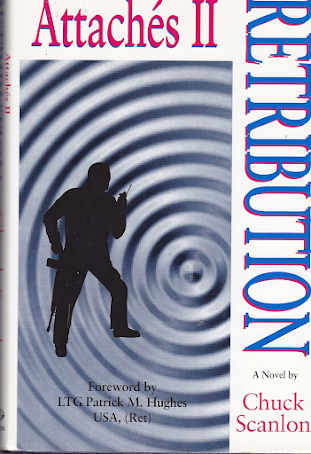
Attaches II - Retribution - Scanlon


Chuck Scalon's "Retribution" is a supposedly a work of fiction.   Scanlon, however, has been in the places of knowledge necessary to know the truth.  A position that few writers of this genre could ever dream of having been.  This is a book about the contribution military attachés make to our government's understanding of intelligence, politics, and the worldwide military situation.  This is a fuzzy business.  What military attachés do is not quite politics and not quite intelligence collection.  Their work occurs everyday and emerges from the simple associations and friendships acquired as liaisons between the military and our political ambassadors.  Military attachés are not spies-- they serve a different government function.  Yes they gather information and produce assessments of the political and military environment on the ground in various countries, but they do not do it covertly -- And they do much more.  They also move information forward to their host country's leaders that pertains to the cause and necessity of various US actions.  It is within this give and take of information that the true intrigue of the military attaché can rival the best Fleming, Ludlum and le Carré have to offer -- but instead of some fictional double agent played by Matt Damon in the movies, these military attachés are real people.  They do not live in the shadows. They exist in the real world and you can find them at every US Embassy with their office number on the phone list.  Scanlon's contribution to this genre comes not from the fast paced edge of your seat suspense of a spy novel but the no kidding, inner workings of a huge government bureaucracy that has not been optimized to either get along, agree, or share the same perspective on a problem.  Whereas the final scenes do force you to turn each page, it is the immense nature of the problem, trying to take disparate information from multiple world wide sources to form a greater understanding of a larger problem, that rings true more certainly than the "shaken, not stirred" variety.  But this book is larger than the life of the military attaché it describes.  Within it's pages is the shocking reality that Scanlon was writing about the terrorist events that would transform our country in 2001, three years before they happened.  The personalities involved are now household names and the events as they might occur are now well known -- they were not in 1998.  Perhaps these published warnings to our country were missed when Retribution was published in 1999.  However, in 2008, the call to action is still as valid as it was back then.  The bad guy never sleeps -- neither should we.

Walk This Way - Davis

I arrived late to the Blue Army, in fact I didn't see Aerosmith live until October 1998 at the Nissan Pavilion midway through their "Nine Lives Tour".  Now, over eleven years after that gig I've read their biography, "Walk this Way" told through the mouths of the Band and fashioned together by the talented rock & roll biographer Stephen Davis.  I was not expecting a five-star read.  First, this is not literature in any sense of the word. It is not a written story. It is the transcribed oral history of an extended interview with the insiders of the band taken from the memories of their lives together over their first three decades. Second, as I write this, their story continues.  Aerosmith is finishing their fourth decade of hard rock and at 61 years of age Steven Tyler took a tumble off the stage during a performance in South Dakota busting his shoulder and splitting open his head.  Aerosmith has subsequently cancelled a few tour dates to, "get healthy".  These guys never quit.  In the late sixties they dreamed of becoming rock & rollers.  Though hard work in the seventies they did it and provided an American response to the British invasion.  But then they fell, hitting rock bottom in the eighties.  Their music lived on through the influence it provided to several generations and genres as they, Aerosmith, continued to destroy themselves from within.  They fought with each other, they fought against the darkness of drug addiction, and they fought against the industry and agents they had trusted and relied on. But they recovered, all of them, and arose from the ashes alive, like no other band has ever done.  And now at the end of this book, during the "Nine Lives Tour" they had climbed back to the top,  with clear heads and a sober outlook on life to arguably become the greatest rock & roll band of all time.   

Are they American hero's and role models who overcame the vices of their industry or are they villains and the representatives of all that is wrong with the glorification of excess in a culture of sex, drugs, and rock & roll?  Joe Perry is quoted as saying, 'I don't want fans to think we're clean, upstanding American boys, but we are American, and we do stand up."  We can argue all day about the influence and glorification a rock & roll culture might have on our children and we can provide our children a wholesome family life attempting to shelter them from the tyranny of drugs and sex and the violent energy of hard rock.  We can, in essence, shelter them from Aerosmith.  But then they will never hear the simplest and perhaps greatest lyrics of all time.  And personally I cannot find a thing wrong with this message.

"Sing with me, sing for the years

Sing for the laughter, sing for the tears

Sing with me, if its just for today

Maybe tomorrow the good lord will take you away

Dream on, dream on

Dream until your dreams come true..."

"Walk this Way",  is a candid look into the lives of not just Aerosmith but the life of American rock & roll.  If you are an American and can stand up, up-standing or other wise, and have ever listened to rock & roll and been alive during the 70's, 80's, and 90's, this book is your biography as well.  Where were you in 1975 when "Toys in the Attic" was release?  Where were you in 1980 when Joe Perry left Aerosmith?  Where were you in 1985 when he returned?  And where were you, in 1989, when you first heard about love in an Elevator?  Aerosmith is American rock & roll and we are all, wittingly or not, all members of the Blue Army. 


Tubes - Blum

In his first book, “Tubes” the journalist Andrew Blum (a writer for Wired), brings us an accessible book about the Internet.  Other books talk about the internet as if it were some ethereal place, the cloud, the net, cyberspace, etc. Blum attempts to capture the Internet’s physical reality in order for every user to understand and visualize what it really means to go to the internet.  In part, because he really does go to the Internet.  Not through his computer, not via some “Fantastic Voyage” where he shrinks to the size of an information bit and shoots down the copper and glass fiber connections of the internet to visit all of its body parts.  But rather by walking out his back door, following his ethernet cable, and tracking down one by one the building, facilities, and infrastructure where the bits and bytes physically go.  They can’t really go into a cloud can they?  The internet must exist in physical space...and so began his journey to the “Center of the Internet” to track down these physical spaces.  

Unlike science fiction stories, Blum’s journey to the “Center of the Internet” was both real and successful.  He found it.  Which is why his book is so good.  His discoveries at the very core of the internet provide us the correct context for understanding not only what it means to be on the information superhighway, but the correct way to use it.  When you finish the internet will no longer be a mystery to you.  Now it takes some thought.  This is not a book that you read and the answer manifests before you.  And it helps if you have at least considered previously where all these bits and bytes go.  For one, there are no pictures.  This is a shame because first Blum starts by talking to individuals who make maps the internet and second because he organizes his research into chunks of the internet that could easily be strung together with a couple of simple diagrams. But the information is there to build this diagram in your mind...but you have to think it through while mapping for yourself the things he talks about.  It helps to keep Google Earth up and running near where you are reading.

Blum also chose not to write a highly technical description of the routers, and servers along with the internet protocol that seamlessly work together to provide the illusion of an ethereal cyberspace.  Again, he delivers just enough that if you want to type internet protocol (IPv4 or IPv6) into Wikipedia you can swim as deep into the material as you need to go to fully understand how your bits and bytes are thrown around using what amounts to the first true genius of the internet.  Without the internet protocol, there is no internet, so it’s worth understanding.

Later in the book he briefly mentions an procedure anyone can do from their computer known as traceroute.  He doesn’t tell you what to do in the text but it’s easy.  In Windows Vista got to your START menu and choose Run.  Then type CMD into window to open an MSDOS Window.  Now you’re closer to the guts of your computer and the internet than most of us ever want to be.  At the command prompt type in “tracert” followed by a space and your favorite internet website...www.google.com or www.facebook.com are easy enough.  If you want to go to Europe pick something with an .eu like www.europa.eu for instance.  Then press return.  Bang...the bits and bytes leaving your computer are mapped through the physical network to their destination right before your eyes.  No more mystery.  Why Blum chose to let us figure this out for ourselves was a balancing act he must have done with his editor.  Since it reduces the technical jargon in the text and but still compels us to it ourselves, it makes for a richer experience.

If you chose to run a “tracert” look through the list of places the  journey from your computer has taken.  You will see your local router, then the router of your internet service provider.  Soon you will be out on the fiber headed towards an huge internet exchange. From there you will be off to perhaps several more exchanges, and if you choose to go to Europe, rocketing through an undersea cable to an exchange in London or other major exchange.  Then it’s off the the destination where your website is hosted on a server, perhaps at some giant data facility like Google or Facebook.  It’s really quite simple, but also really quite fascinating.  Andrew Blum as produced the right combination of history, technology, and geekdom to open this ubiquitous world to everyone.  

One question remains...who is paying for it all?  Blum fails to all but crack open the door to the financial side of this world...and it’s not clear why he backs away from this topic as well.  Since he is only talking about the infrastructure we can skip who pays for the free services we use such as Facebook and Google, they have their own elaborate finances that seem to deal with advertisers which pay for their colossal data centers with thousands and thousands of servers.  The rest of the infrastructure consists of the communications lines, like undersea cables, and the internet exchanges.  The cables are easy, they are paid for by investors, and the cables themselves are a resource that can be purchased or most likely leased.  We pay our ISP, who in turn builds the network close to home and into the back of our house.  What remains is the huge internet exchanges owned by companies like Equinix.  They have a separate model...and it is this model...and the ability to make money from this model, that creates the internet we know today.  It is the core...the center of the internet. And worth a journey to Ashburn Virginia to see, if not simply to drive by the buildings where it exists. To point to and say to your kids in the car, “behold, the internet!”.  Without that building in Ashburn nothing works.  There would be no internet.  So who is paying Equinix?  Someone definitely is...and that is the second true genius of the internet and the most compelling part of Blum’s work.  As it turns out most of the relationship around an internet exchange are not physical at all, they are human.  And where human’s meet in a marketplace, money changes hands. Equinix simply provides for this marketplace, like a flea market...without which there is no internet...genius...and I for one thank Andrew Blum for taking me on this journey with him.

I’m giving this book 5 stars.  It has flaws...but it’s a must read for everyone who uses the internet.


Saturday, November 11, 2023

The Bomber Mafia - Gladwell


I finished Gladwell’s book, “The Bomber Mafia” in less than a day.  Not difficult if you’ve spent  four decades in and around the United States Air ForceI spent my formative years in the Strategic Air Command (SAC) weighing the morality of high altitude  bombing, both conventional and nuclear, preparing for war as a part of the strategic triad.  And of course, the first Gulf War, in 1991, ushered in the first and most telling use of the GPS constellation for precision bombing.  The mighty B-52 bomber aircraft, getting old at the time, still in noble service to our country another 30 years later, became new again as a large truck to haul many of these precision munitions. Gen John Chain was the last of the Bomber General’s that ended what military historians such as Jeff Smith (The Future AIr Force) call’s the rise of the Bomber Generals, one of sevearl epochs of the USAF through it’s maturation as a armed service.  After that came the Rise of the Fighter Generals (Mike Worden), an epoch the USAF is slowly  evolving away from, both with the increasing use of unmanned systems, and of course with the new break off service, the United States Space Force.  

Beyond the great storytelling is one simple fact.  If you are a military history buff, read military history.  Gladwell doesn’t write for historians.  He writes the equivalent of pop-history as he does for the things in his other books, such as analytics and sociology. He writes for his audience to hear a great yarn and learn a few things, hopefully cutting through the chaff and flares for the occasional profound insight into the human condition.   It’s not like these stories from WWII haven’t been told before, numerous times, and in many Hollywood treatments as well.  What Gladwell nailed, in this short collection of stories about WWII and the early Army Air Forces, before we had a separate Air Force,  is that some military leaders are profoundly moral. Some military leaders are great tacticians of war and build a careful plan of action that solves a set of complex problems that lead to positive outcomes.  Also, Gladwell tells us, some military leaders are sadistic. In this manner, Gladwell always captures the richness of human behavior, it’s idiosyncrasies, along with our many strengths and weaknesses.  He doesn’t pass judgment, just puts it out there for us to consider right and wrong for ourselves.

Anyone in the military should have studied WWII in great depth.    Anyone who considers themself well read has also read the fiction coming out of WWII.   Novels such as Slaughterhouse V, by  Kurt Vonegut, and Catch 22 by Joseph Heller.  Great books of military history abound be they histories of various military campaigns, the political posturing, biographies of the great characters…many not so great.  Recent histories of World War II include the stories of courage and the many thousand’s of personalities.  Recently the story of Louis Zamperini, and B-24’s in the Pacific, told by Laura Hillenbrand in “Unbroken” captivated the Country.   WWII will continue to be studied by historians for the length of human existence…but of it’s lessons for the masses and ordinary citizens, it will be but a passing chapter in high school history books.  Unless, great stories and anecdotes told by great authors and storytellers like Gladwell (and Hillenbrand) persist. 

The sheer horrors of war, Gladwell does more that hint about the furnace, the tinderbox homes in Japan where 100,000 died in the napalm firebombing.  He glosses over Dressand theo topic of Voguts nightmare, attributing only 20,000 to a conflagration that probably cause similar numbers as Tokyo, but goes on to remind us that Curtis Le May, fire bombed Japanese cities as many as 67  times, a fact that get’s whisked away in the days after Hiroshima and Nagazaki, and beyond teh horrors of a confligration, inwhich human babies ignited on their mother’s backs as the hellish furnace of the napalm conflgration consumed every life in it’s path, the horrors of radiation sickness soon materialized.  Like Vonugut, you cannot not read these passages and find any nobility in war.  The book “War is a Force that Gives Us Meaning”, written by Chris Hedges in 2002, is tells us perhaps, why humanity wages wars. Gladwell reminds us why we must continue to find ways to solve our differences peacefully even in the midst of wanting to strike out at those who oppose us, conquer us, or lead us into tyranny.

To be sure there are technical errors and errors of historical fact.  But that does not detract from this story of what happened.  This is not a revisionist history of WW II arieal bombing as some of military critics of his work have stated.  These men existed.  These bombing missions happened.  The results are historical fact, Germany was defeated.  Japan surrendered.  

The Bomber Mafia grew up in Maxwell AFB, in Alabama, by technologies believing several things…  Air Power could help bring wars to a close faster.  The method, precise aerial bombardment of strategic targets that could cripple and adversary's ability to wage war.  The doctrine of Strategic bombardment to  crush critical nodes of production and transportation is sound.  That doesn’t preclude the use of boots on the ground or naval blockades or the coming required to own the high ground in space.  Those advocates of singular domain centric war fighting strategies are either idiots, having studied joint doctrine, or are simply arguing for a larger share of the defense budget…  They can’t really believe anyone can prevail in war without all it’s levers. But the visionaries of Air Power, and control, superiority, or supremacy, in and from the air, are not singularly the thoughts of this bomber mafia or the diffrences between Le May and Hansell.  Where is Giulio Douhet, where is Billy Mitchell,  John Boyd,  John Warden?    Hansell was basing aerial bombardment on strategy and morality.  Le May was getting a job done.  These are not mutually exclusive.  But it’s worth noting for air power was a revolution in military affairs.  Many aspects of air power for a multitude of reasons.

A lesson for the current technology mafia that believes with unwavering optimism that the revolution in military affairs before us, has to do with software and networks.  

All the technology in the world, the B-29, couldn't overcome with technology (the Norden Bombsight) the environment which it was forced to fight in either theater.

The sheer mass required, the range, and the environmental conditions.  Sure, the analog nature of the bombsight couldn’t adapt flexibly enough to the changing conditions, whereas software could recalculate…yet software can’t really extend beyond the realm of ist’s analog (physical/kinetic) requirement to kill people and break things.

Much like, instead of precision, high altitude, daytime bombing (with bomb site), of strategic choke points,  Moved to night time, low altitude, area bombing, because  no air defensese exiosting.  What allowed this change was a strategist (Le May) not tied to the doctrine of aerial warfare, but the doctrine of solving problems faster than the adversary can react.  Flexibility is the key to AIr Power (Douhet), react faster than your adversary (Boyd).

Interesting stories…

Developnet o the norden Bomb sight, its been told a miliion times…  can such a precise analoge instrument be combat ready and take the abuse of combat particularly if mass produced…thousands were required.  

Development of  Napalm by neurotic pyromaniacs in Cambridge MA.  

Sadistic area bombing of civlians due to the terror of the advesary area/terror bombing of yoru own homeland durign the Battle of Britain.

Sadistic area bombing of cvilieans due to what appears to be 1) revenge for pearl Harbor 2) racist stereo typing of an entire culturee.  Who was more human… Japanese gave Le May a metal not for conflagrating perhaps a million of their citizenry, something the Atomic Bombs never came close to doing, but because Le May turned around and assisted the Japanese people in building an air defense.   

Flexibility of air power through deliberate change in CONOPs to overcome the descent not realized in the advanced technology of air power but the flexibility of air power itself.

3-dimension of maneuver room in the battle space pulse time.  Ground and sea forces are by and large restricted to 2 dimensions plus slower time, and space, believe it or not, fights in a single  dimension, and doesn’t even have the flexibility of time.  

Because of this new invention things will get better…

RMA 

Warfare remains hard.  There is no single technology that changes the outcome. Some technology has indeed become an RMA but they are few and far between and they were not viewed as RMAs at the time.  Andy Marshall didn’t coin the phrase until 1991.  But it’s easy to argue that  Gun powder significantly changed things.  Air power significantly changed things.  And finally, PNT from space significantly changed things.  That’s about it.  The current argument that integrated, netted, webbed, everything with AI and agile software development will now be an RMA is simply wrong.  Gladwell doesn’t explicitly start out shooting that particular RMA in the face, but he presents a pretty good case for it.  The Norden Bombsight, perhaps, being the technology that would usher in daytime, high altitude, precision bombing…which would change everything.  It didn’t.  The argument for the RMA will only be a reality if the CONOPS and Tactics involved in the operational art of war also change. Those don’t change with the technologies currently on the table.  If a software change is necessary to fix a problem (something isn’t working right or a vulnerability has been discovered) that doesn’t change the way we fight.  It would be nice to fix it, fast, but not at the expense of creating a bigger problem that hasn’t been understood or grasped (training issue, new vulnerability, untested)

If you bomb people, unless you kill them all (Cathars in Besnzie), people become more resilient to a cause, war is a force that gives us meaning.

Warfare crosses more than just physical domains air sea and space, economic, political…

There are tradeoffs, there are heros, there are idiots, there are arrogant bastards, there are lunatics…this is a human endeavor for both sides…

Innocent loss of life must be evaluated and minimized.

Uav/rpa advocates ..  automation vs remote pilotong

Network centric web vs stove pipe

The internet ushered in the belief in a revolution of military affairs in the form of network centric warfare when multiple nodes and decentralized execution, wrought combat power.  Several factors conspired against this reality, yet the advocates continue to believe.  We fight in stove piped kill chaines not because we don’t have open standards but because it remains the most effective way to kill people and break things kinetically, aide the  survival of the combat mission, and minimize fratricide from those who ought not be firing beyond the FLOT or FEBA and into the GRCA beyond the FSCL into the FEZ or MEZ. 

Software disciples

Agile development  vs legacy waterfall 

Agile software development in the vernacular “DevOps” grew up in the miliinal tee-shirt clad, fake it till you make it culture in Silicon Valley where getting to market first was paramount, and software developers learned that Beta Testing could be done for free by the public.  Compare this to the development of software for the space shuttle where software programmers wore suits to work and the code was the closest to error free of any code ever developed.  Does the military need error free code? Or do we want pilots beta testing code in battle?

Acquisition agility

Is not a war fighting conops.  If faced with an existental threat, such as Nazi Germany, acquisition can move rapidly.  We have to buy pass laws of commerce and fair trade to by pass such things a competition to simply field development.  Laws exist under the war powers act to eliminate some of these acquisition hang up.ucusions hang ups.

Space junkies

Space is the ultimate high ground thus it should be its own warfighting service (the won this pissing contest) complete it’s it’s own doctrine, CONOPS, and Tactics. 

Everyone has their revolution.  Which revolution of military affairs has actually achieved a change to the way we actually fight wars?  Certainly airpower in general.  From space, certainly the space based PNT solutions ushered in precision gilded weapons, as well as so many other things that exquisite timing can bring to the fight, maneuver, logistics, and advanced communications.


The Bat - Nesbo

 As a huge fan of Stieg Larsson, what’s a reader to do when the Millennium Trilogy ended?  My boss suggested I move on to Jo Nesbo and “Redbreast”.  Just ahead of my beach vacation I stumbled into B&N looking for where to start and found “The Bat”, the first in the Harry Hole series.  A bit confused, since I wasn’t sure where the series began, I purchased it and headed to the beach, partially thinking there was a reason the publisher didn’t translate this one first.  They started with “Redbreast”, that one’s probably the blockbuster, so I resigned myself to thinking I’ll be reading at least two Jo Nesbo novels before deciding if he’s my next Scandinavian crime story fix.  Of course now it look’s like “Cockroaches” lies between me and “Redbreast” but I’ll sort that out later.

Since Nesbo wrote “The Bat” in the mid nineties we are reading it perhaps 20 years later.  As crime stories go he was entering the genre about the same time Larsson was sitting down in the evenings to tap out “Dragon”.  Optimistically, his writing talents show through even though his sophistication as a crime novelist was just beginning...that is assuming his sophistication does in fact increase through the HH series--to be determined.  In “The Bat”, there really is only a single character that he develops...Detective Harry Hole.  Whereas following the first of the Larsson’s series we are left with several major characters with plenty of potential life remaining.  Regardless, Harry is just good enough, bad enough, and broken enough to have had the alcoholism driven out of him, just in time to for another series of misfortunes to drive his love of drink back to the surface.

In a crowded beach house, with distractions a plenty, it’s hard to find a quiet place to read--yet Nesbo was still able to get me to turn the page.  Yet his most compelling element was not Detective Hole, rather it was his adding cultural stories pertaining to the Aborigines of Australia where between the shores of Brisbane and Sydney, the entire story takes place. Granted that’s not an entire continent, only about 600 miles of shoreline, he introduces us to an urban Australia that we miss in most of the stereotypical depictions of the outback.  His snippets of Aborigine culture are conveyed through the story of the “Bat”, the “Snake”, and a few other tales that have been handed down in some 40,000 years of folklore.  I have to assume he has conveyed these ancient stories accurately, despite struggling with a few other facts, a bit more modern.  In particular, during critical dialogue between the two pivotal characters, Harry and Andrew (the detective of Aboriginal descent he becomes friends with) we learn we wouldn’t want to learn astronomy from either of them.  Still learning something, anything, in a novel provides added value to the intrigue and the entertainment.  Of particular value to me was the legal understanding of the term Terra Nullis which basically applies to the lack of legal ownership of the land that the Aboriginal people occupied, because they did not occupy the land full-time.  In essence they continuously migrated, thus, as we in the west like to say (and apparently down under as well), possession is nine-tenths of the law.  The Aborigines never had possession of anything even though they existed on the continent for more than 40,000 years.  Nesbo cleverly ties this concept to this crime motive although it’s not that compelling. 

In the end I’m giving Nesbo 3-Stars for “The Bat”.  It was good enough to finish and good enough for me to want to crack the binding on “Redbreast” in the near future.  Stay tuned.