Saturday, December 28, 2024

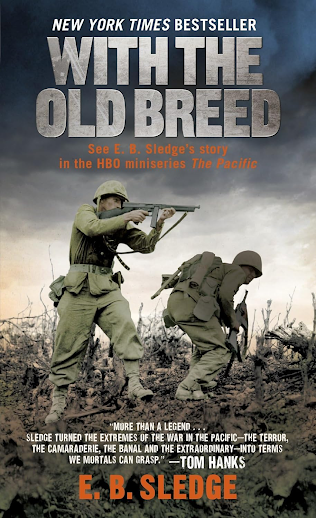
With The Old Breed - E.B. Sledge

Wow, I missed this  WW II classic.  Being mostly associated with the US Air Force for most of my life I’ve missed some of the details of the ground war in the Pacific.  I’m well versed in the use of Air Power in the Pacific and of course Europe. And of course many of the Navy battles, Midway, etc.  I’m much more familiar with the land war in Europe and Africa, having studied many of those battles.  As for the Pacific, we all know what happened at Iwo Jima, as I pass by the Memorial frequently in Arlington.  But, what of Peleliu which I’ve never heard of until reading EB Sledge's classic, “With the Old Breed”.  And then onto Okinawa.  EB Sledge gives us the play by play from the ground.  When a 3-4 day predicted timeline on Peleliu turns into a horrific 30 day bloodbath and then onto the saturated foxholes on Okinawa that was battled ridgeline to ridgeline  against an enemy swore to fight to the death.   I have to get this book 5-Stars, not just because Tom Hank’s endorsement and I’m assuming production credit for the HBO Mini series, “The Pacific”, based on this book and one other.  

E.B Sledge is a scribe.  His writing ability is fantastic.  He  never mentioned whether he kept a journal, or not.  Which, given the circumstances in a fox hole seems highly improbable. But he did write letters, as there is mention that he received letters.  As with any good writer, he has a fine memory, and the ability to observe the events around him, and take mental notes.  His observations of the other things taking place around him, seem to have no counterpart.  The combat yes, his descriptions are graphic, gory, and horrific right down to the battle wounds and the gore of war.  The constant fear he expresses, underscoring the ability of a common man to will himself into battle, follow orders without question, and do what has to be done. Which he accurately attributes to Marine corps training and the every vital esprit de corps of a brotherhood.  He wills himself into battle every minute, while still, trying to maintain that ounce of humanity, from which crossing over means certain insanity.

As a case in point, the taking of trophies from the dead adversary’s lain strewn about being one graphic detail where a line must not be crossed.  The line seems to be, knocking out the gold teeth of a dead combatant, which was widely seen as valid.  However the taking of a body part, was over the line.  EB Sledge, distraught and angry, was going to take such a souvenir (a gold tooth)  when a senior NCO questioned him and brought him to his senses, lest he cross that first line of humanity. He settled for the rank lapel of the dead soldeir.

No better example of the ineffectiveness of airpower exists when the enemy is fighting from every ridgeline and every cave in the vicinity.  Boots on the ground is the only way to take and hold territory and when the enemy is committed to fighting to the death the assaulting forces must oblige, at the sacrifice of their own flesh and blood. Fear in the foxhole was constant, with the soldier questioning their duty in concert from their shear unrelenting misery, from the battle raging around them, to the continuous physical effort to resupply and remove the injured and fallen, to staying alive through a night full of treacherous enemy infiltrations, in a cold, wet, and muddy fox hole.

The book is written in three parts.  His Marine Corps training, at boot camp, in San Diego, is reminiscent of any of the many fine descriptions of training.  Early in my career I had the privilege to spend a week at the MCRD in San Diego, drilling daily, walking “fire watch”, and running the obstacle courses, in particular the confidence course where you must do things by sheer will alone.  I am not a Marine, it was just an opportunity to catch a glimpse of what training was like.

The second part of the book is the play by blood play taking Peleliu.  The battle for that island, or coral atoll that seems to be somewhat strategically questionable.  Principally because after the 30 day battle, Sledge discovers, unfortunately, that MacArthur has already landed in the Philippines.  Peleliu, previously given by MacArthur as a must have, prior to his landing.

The third part of the book is the assault on Okinawa, and truly a pivotal battle of the Pacific, on the way to Japan.  At this point, Truman has already authorized the nuclear bombing of Hiroshima and Nagasaki, which would bring about the Japanese surrender.

Since there are many fine reviews of this book, I will not recount the play by play as many have.  It’s an important read.  It’s well written.  You will turn page by gory page to discover the mind of EB Sledge in combat.

One artifact I will leave you with, is that not only is Sledge the right scribe documenting the right things from his observations, we are granted the serene knowledge that this philosopher, similar to the observations of Victor Frankel, in his epic “ Man’s Search for Meaning”, a great observer who witnessed the brutality of horror of several concentration camps, Auschwitz, etc, and survived great odds, yet lived to tell us about it. So did Sledge, surviving countless odds, with bullets passing within inches of his head, continuously.  Sledge gives us the ability to see beauty from the midst of dark despair and  deeply depressing conditions, including maggots, and the unrelenting stench of the dead.   He gives us this, “I walked under a low tree that had a pair of man-o-war birds nesting on its top.  They showed no fear as they cocked their heads and looked down from their bulky stick nest.  The male saw little of interest about me and began inflating his large red throat pouch to impress his mate.  He slowly extended his huge seven-foot wingspan and clicked his long hooked beak”.  Simply stated, Viktor Frankl would be proud of Sledge for including this observation.


Monday, December 2, 2024

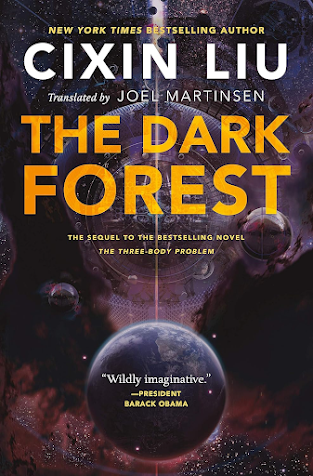
The Dark Forest by Liu Cixin

As imaginative as the first book of Liu Cixin 3-Body Problem trilogy was to science fiction and technology, the second book, entitled “The Dark Forest” creates a nemesis that must be fought with an even better creative and imaginative strategy.  The dark forest strategy itself can't be considered a spoiler in this book review because it is the title.  Literally the dark forest is a term coined by early science fiction writers to mean  if you want to survive in the forest and not be eaten, as a part of the food chain, you must remain quiet.  If you make a sound you will be eaten.  Extrapolating to the cosmos, if there is alien life on other worlds, we must not, as a planet, be a beacon to those other worlds, lest they come to annihilate us.  Which, as described in the first book, is exactly what’s about to happen.  Whereas many of my friends found this book to be the best of the trilogy, I rate it as my 2nd favorite.  I was so happy with the “3-Body Problem” and the introduction to this technology, and the accuracy of the dilemma Liu Cixin introduced, that the solution, in the form of the strategy of the second book, was just a necessary response to his ideas.  Also, I’ve spent my entire career thinking about strategy, whereas his use of game theory, to divine the intentions of an adversary, are second hat.  Not to reduce Liu Cixin’s book in any way, as I said, many find it to be his best, it is, at its core, a book about strategy, and not so much the science fiction, that was the first.  Once he created the science fiction, and the story line, the strategy is just the strategy and how it plays out.   The Netflix series doesn’t end at the first book.  It dives into the second book with the introduction of the key concept of the “Wall Facer”.  On Earth, the strategy they come up with to defeat the attack of the Tri-solarians, albeit 400 years in the future, is to appoint four individuals to come up with strategies in their minds.  Strategies that would be completely secretive that the Tri-solarians would never be able to figure out.  The book traces out the arc of these four Wall Facers through time as their strategies are slowly revealed and defeated by the Tri-solarians as each secretive strategy is uncovered.  The twist at the end of the 2nd book is as good as any twist in any mystery novel and caught me flat footed.  It was, perhaps, the best ending to any science fiction I have read.  Not sufficient to move it into my favorite of the trilogy however.  

I will give Liu Cixin another 4 Stars overall for the book and the trilogy.


Saturday, November 30, 2024

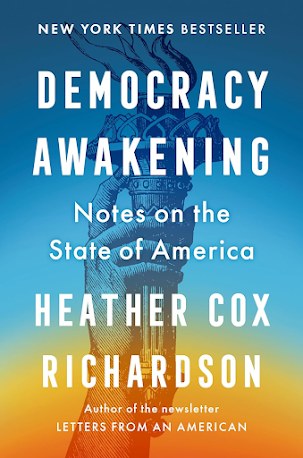
Democracy Awakening by Heather Cox

 I was happy Heather Cox Richardson had the time, passion, and knowledge to give us these notes.   I believed that every American should read this book and refresh on why America is great and why we don’t need to make America great again.   I didn’t do much public advocacy for my political leanings…I’ve said many times before my views on Trump.  I am an independent that leans conservative…but that has only earned me the title of RINO from my friends in the red states.  So, instead of writing my own thoughts on FB, I simply pointed to Richardson’s Blog….because she says it all.  And much better than I could….however, now it’s post election and I am finally writing this book review.  I feel that as valuable of a book this was before the election, it is now not worth the paper it was printed on.  As promising as a treatise on why Trumpism is a clear and present danger to Democracy in America, America doesn’t agree with Richardson.  Donald J. Trump was elected President of the United States on Nov 5, 2024.  Did Democracy win?  Or did Democracy just suffer a five finger death punch?   Are we now in a freefall racing toward the arrival of Fascism?  Maybe, maybe not.  One thing is certain, we fucked around, now we are gonna find out.  I don’t find the lessons for Richardson’s book that compelling anymore.  Rather, they are simply the bloviating opinions of the self righteous, hand selected from a litany of many other stories from history.  In hindsight I should have known I was deep inside the echo chamber.  Most of the progressive pundits agree with stalwarts like John Stewart exclaiming, the polls don’t know shit.  Clearly hindsight is 20/20.

I read this book six months before the 2024 election.  I was thinking smart books like this are important to get out there in the world.  My assessment at that time was that Richardson has put together a very nice collection of tales from the history books that brings us to where we are now, seemingly, on the brink of losing our Democracy to lunatics who want an authoritarian government.  Most of us don’t have the time to look through American history and find those important facts…the ones we learned in school but have forgotten about. Or we just remember the wave top details…more like parables in the Old Testament, then the really rich stories from history where we actually have a preponderance of the facts.  Unlike the Biblical parables where we don’t know exactly.  Certain facts about American history that we have thought to be inviolate should be black and white…like the Bill of Rights and Checks and Balances.  Those things about our democracy that were copied by other democracies where we, the United States of America,  lived out the white picket fence dream with the promise of truth, justice, and the American way…without actually having to have a real superhero.  Our Constitution with our system of government was the super hero.  We were the beacon on the hill.  Three branches of government to ensure the checks and balances necessary to prevent the reigns of tyranny from usurping the will of the people.   The envy of the world.  This is the stuff of American history.  The trials and tribulations are always present, but the retention of our American Republic and way of life was always the outcome. 

Richardson opens her book with, “We are at a crossroads..” Meaning, a decision is at hand.  Take the blue pill and return to the peaceful sanctity and normalcy of the progressive life the country has created since the true awakening of the 60’s.  Peace, love, and understanding along with the first female in the White House.  Take the red pill and see how far down the rabbit hole those disenfranchised by the progressive agenda are willing to take the Country to make us “Great Again”.  She ends the book with describing the looming election as a test, and places the fate of our American society back into her readers' own hands.  The election is up to us. Now we get to choose.  Except, her readers already knew their choice.  Her readers are not the ones who got to decide.  The ones who decided, didn’t read her book or her numerous blogs, nor did they read the things I have written.  Case in point, I posted one of Richardson’s blogs on my FB account.  What I got back from my Trumpian friends who commented revealed very quickly that they didn’t even read what I had posted.   

What’s abundantly clear is that the Americans who voted for Trump don't read Heather Cox Richardson.  This is why the book is worthless.   I don’t need to read this book.  I wasn’t voting for Trump before I read it.  So it was a waste of time.  Perhaps I should have been spending that time convincing a few of my friends that they are idiots for voting for this criminal.  Yet they also knew this…so it’s clear…the majority of Americans were ready to take the red pill.  We knew this since January 6, 2021.  They had already swallowed it, they were just waiting four years for it to kick in.  And now it has, with a vengeance.  So as I write this book review, what of anything Richardson has written is worth reporting on? Why do we think we are the keepers of liberty and justice and that the red voters just fucked us.  Could it be…something different?    Richardson tells us how it all fell apart.  The slow slide towards authoritarianism began in 1930 when FDR rose to power, and stayed by the way--authoritarian style--for a few more years. Hating business, in a capitalist society, all the while.  But what she means is how it fell apart for us.  It didn’t appear that it fell apart for those disgusted by the progressive agenda foisted upon us by the far left.  Why did we think, of course, we need to elect a female president?  We need to show the world we truly believe.  That, our great country is not made up completely of the basket of deplorables described by Hillary Clinton before she lost to Trump in 2016, but a diverse collection of everyone who believes in freedom.  We can’t keep saying those on the right are sexist, racist, bigots who cling to their bibles and guns.  We have to address why a careful reading of Richardson's history of America is completely wrong and not worth reading.  Why did the majority of the Country not vote for Richardson's awakening democracy?  

I am not afraid of the future.  I have not suffered the same anxiety many of my liberal friends and family have suffered.  Instead of fearing for the future I have tried to look at it from those jubilant in the Red states.  Jubilant that they, in fact, have saved democracy from us.  Those that truly believe Trump and his cronies will Make America Great Again.  Believing in that red wave of hope…means believing in my friends who are happy and excited about the future.  I can embrace that…and it makes me happy to do so.  It makes me happy for them.  I can also embrace the coming restrictions of business, which of course, upon which capitalism thrives, being lifted.  While I may be an independent moderate, I am 1000% a capitalist.  Capitalism is truly the only system of society with a chance at keeping us civilized.  What we are headed for, in the best case scenario, is not toward Fascism  but a version of capitalism where the robber barons of the late 1800s rape and pillage the land and the people…included my blue collar friends who voted them in, in a effort to enrich themselves.  This would be the exact opposite of socialism that these same friends loath, against their own self interests.  In these very big companies…such as anything Musk, and everything Amazon, the growing prospect of Unions is now very real.  It’s no wonder Musk aligned with Trump early…and Jeff Bezos,  that sell out coward, demonstrates where his true loyalties lie…deep within their own pockets.  I hope the coming unionization will crush them and crush them soon.

This is where Richardson fails.  She does not see, or she doesn’t realize, that our democracy is tied hook, line, and sinker to capitalism.  Thus reporting on the aspects of why the governance of our country is correctly structured, that structure is forever linked to capitalism.  Capitalism is the true keeper of the flame of why we have legislation and a judicial system.  Business is the business of America.  It needs a framework in which to thrive but it also needs boundaries to keep it somewhat in check.  She should read a few more books on the history of business in the United States and perhaps this wouldn’t have been a true blind spot for her. 

The government is an illusion.  The country will continue to prosper, notwithstanding the prospect or war.  Half the country has a surge of energy and will ride the wave of happiness for a while.  Capitalists will capitalize and the economy will boom.  We will ride this wave of prosperity upwards…as will the new robber barons...into a much greater division of wealth between the haves and the have nots.  This will continue, ultimately, until the country can build the infrastructure that makes energy ubiquitous.  Once energy is ubiquitous, it will also be free.  Once free energy arrives politics will cease to be necessary.  Human’s will still seek power, but governance will be more like the power bestowed about the leadership of a homeowners association. Humorous, but mostly Karen's, and mostly annoying.

Six months ago I gave Richardson, 4 Stars for this hopeful read.  Now, finding it all inconsequential I can’t give it more than 2 stars.  Who would ever go back and read it now. 

Thursday, November 28, 2024

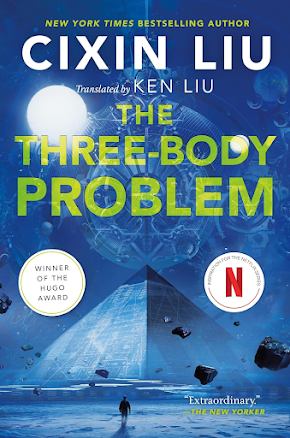
Three-Body Problem by Cixin Liu

Before reading this book I watched the Netflix series…then I listened to the novel on audio books, before purchasing the hard copy.  So much can be said about this book, and having won so many awards, it’s difficult to find an angle that hasn’t already been addressed.  Clearly I am a fan.  Liu understands all of the science he writes about and turns it into fiction in a very credible way.  He is the Carl Sagan of our times.  And he expands beyond the adroit Sagan’s astronomy and cosmology to take  us into all of the technology necessary to  achieve all of the truly fanciful stories he creates about how we are going to make first contact with an Alien species.  Then, only to find out,  the worst possible scenario.  Damn, the universe isn’t a big beautiful benevolent place, rather, it’s just like the jungle.  Survival of the fittest is the prime directive.   Not something more altruistic such as, first do no harm, as the Hippocratic Oath might be applied to the discovery of alien worlds.  No, in the jungle, hunt, or be hunted.  In this book, a naive radio astronomer makes first  contact with the Alien world, the “Tri-solarians”, and for the survival of their species, they tell us they are coming to Earth, to kill all earthlings, and take over the place.  The catch…which makes the science particularly credible, to get to earth it will take 400 years of space travel.  Plenty of time, if you are on earth, to have any number of reactions. Running the gamut from, “Who cares?”,  “Aw Shit, we are Fucked”, to being a sympathizer on their side if you already hate humans, to going high order in a way necessary to defeat the bastards before they get to our planet.

He is creative in ways that are refreshing, such as his correct use of actual science, computer gaming,  computer technology, radio astronomy, and  space control, and at least speculatively correct in ways science could be used for the more advanced magic that is necessary for some of his futuristic aliens to prepare their way on as they journey here.  For instance, wanting to freeze our technology at its current level, lest we invent ways to defeat them in the next four hundred years…aka, being more advanced than they are upon their arrival. And the use of quantum entanglement to communicate over the great distances.

One of my favorite parts of this book, and the NetFlix series, was for the Tri-solarians to create a computer using 30 Million physical  objects as binary gates, thus creating the largest computer in the history of the universe.  The book describes this quite well.  The TV series illustrates how it might work in CGI.

An additional insight one cannot refuse to acknowledge is the fact that Liu wrote this book in his native language of Chinese and it was translated to English by his brother.  How well this book holds up in English is either a testament to the translation or simply the compelling nature of Liu’s story.  I think both were necessary to achieve such acclaim for this story.

This book is a must read for any science fiction fan.  As I have already completed the trilogy…which includes the second novel, “The Dark Forest”, and “Death’s End”, I can tell you that this is by far the best of the three that scratch science fiction writing.  I’ll address the others if independent book reviews.  Five stars, if I was still on Amazon, for “Three Body Problem”.


Sunday, January 14, 2024

The SPY in Moscow Station

One review I just read of the book “The Spy in Moscow Station '' by Eric Hazeltine, advises the reader of a spoiler alert and then reports, “The Spy” is not human as if somehow the title infers that to be the case.  In the end, the spy turns out to be a highly technical listening device implanted in the US Embassy in Moscow (Moscow Station) in place to extract keystrokes from the IBM Selectric typewriter in the US  ambassador to the USSR’s office. So not human. The implanted device was in the typewriter the ambassador would  use to type letters for the State Department.  Not to spoil that particular reviewer's fun (He was a former CIA muckety muck), but that is exactly what spies do.  It’s strange that he would say such a thing. Technical gadgets are a must.  So there should be no spoiler…I guess that reviewers' experience was at the CIA, where HUMINT and the use of human assets to provide intelligence is the game.  He also felt Hazeltine was grinding an axe about the CIA sometimes not taking the NSA seriously.   My point is simply that in order for those implants to be in the embassy, and be useful, it took an army of human spies (not one spy), inside the fence, to put them there, and be in  place to make the extraction through the operation of the technology. It’s a team effort.  That army of spies committed years of effort to keep the device alive and functioning so they could meticulously funnel out keystrokes from a typewriter.  Think about that for a second.  As I type this book review, should someone be recording keystrokes, they would have to listen (record) for hours and hours, perhaps days, over which I will start and stop, and backspace, and cut and paste, etc.  Also, there were 250 IBM Selectrics in Moscow Station at the time.  Implants were found in about 16 of them.   It’s eye-watering to think about the scale of effort the Soviets committed to this endeavor and it was a watershed moment for the United States when our government finally learned the extent of the breach and conceded the French were right.  The French government tipped off the US that the Soviets might be doing something along these technical lines since they discovered a similar implant in their communication gear.    I first read about the Gunman Project, the name given to the search for this particular implant, in Nicole Perlroth’s book, “This is How They Tell Me the World Ends' ' so I recognized what was happening in Haseltine’s book almost immediately.  Of course, I said to myself, this is the IBM Selectric implant fiasco.  Then I had to read the next 242 pages to get to the punch line. Perlroth’s chapter on the Gunman Project is less than 10 pages.  So Hazeltine reports a lot more on the technical side than Perlroth describes, most of which, however, comes from an academic paper written by Sharon A. Maneki in 2012 entitled, “The Gunman Project”.  This was written for the Center for Cryptologic History at the National Security Agency.  Hazeltine also references this paper but also conducted hundreds of hours of interviews with Charles Gandy, whose involvement in the project was not reported on by Maneki, perhaps for security reasons back in 2012.

A few caveats up front.  My boss recommended this book.  When your boss recommends a book  two things apply.  One, you should definitely read it.  Two, you should generally agree with your boss's perspective. My boss made a few mea culpa’s about the book, because he’s a nice guy, and acquiesced away from responsibility should I not like it.  It’s my fault if you don’t like it.  He knows I write critical book reviews and can be a dick when a book doesn’t rise to my level of satisfaction.  Also, my boss is an expert in the subject matter.  So if I didn’t like it…perhaps it would be because I did not understand it.  Never fear, I liked the book so here is my positive review.

There are three distinct aspects to  this book which are unique.  

First, Eric Haseltine was a former director of research at NSA.  He held that position for three years in the early 2000s just after 9/11.  This is discovered early in the introduction by Gen Michael Hayden.  Gen Hayden hired Hazeltine from Disney to spark innovation at the NSA.  Whether that happened or not is debatable.  This book, however, isn’t about Haseltine’s time at the NSA, although it’s an interesting discussion point given the seemingly controversial action related to his being hired.  There was a lot of talk in the community that the US Government had hired the Disney Imagineer.  It turns out, the only thing I’ve found that this Imagineer accomplished was to influence the seating arrangement of analysts who sit on the Ops floor of various intelligence centers.  I’ve truly discovered nothing else.   

Second, this is a book about political relationships inside the intelligence community, in particular the rivalry between the NSA and the CIA as the NSA struggled to come to grips with its charter.  This is the axe the other reviewer from the CIA thinks Hazeltine is grinding.   This rivalry still exists today which is a huge detriment to the country.  Hazeltine, as an outsider, was in a key position to observe this tremendous power struggle.   But we all know about the power struggle.  It’s never been a mystery and occurred as soon as the NSA was established.   I think generally speaking, the NSA is an organization whose existence is highly dubious…their technical prowess exists elsewhere. This may seem like a controversial statement but the NSA is the organization that continuously gives intelligence a bad name for having the means for spying on the American public.  To counter this dubious side of the NSA, the intelligence they collect is locked behind legions of lawyers trying to keep the lid on potential missteps that could lead to violations of the constitution (inadvertent spying on Americans).  This lock down of intelligence for legal purposes thus prevents vital intelligence from making it into the hands of the warfighters who actually need it.  Undoubtedly an objective of Hazeltine’s work was to highlight the ineffectiveness of a government at odds with itself. I also personally disagree with the NSA’s belief that they are in a better position to inform the President.  The CIA is absolutely correct.  Technical collection is meaningless without context and it requires human analysts to provide context.  This will never change.

Third, this is a book about The Gunman Project, which reports on the technical implants I mentioned above  in the US Embassy in Moscow that were exposed by Charles Gandy.  We can argue their value, but the Soviets sunk untold resources into creating the implant and operating it for perhaps a decade.  Maybe they debatably gained nothing,  that is short sighted.  They learned how to do it, and they learned it could be done.  Tradecraft is everything. Also, the only reason we pursued the implant was because the French government found an implant of their own in one of their networks and tipped off the United States to be on the lookout.  I like that Charles Gandy gets the credit for all of this thanks to Hazeltine.  He was left out of the previous history on this topic.

Perlroth never mentions Charles Gandy.  Gandy could also be called the spy (or counterspy) in Moscow Station.  He uncovered almost everything necessary to act in 1978 but then failed to get the Country to act on what he discovered for another six years…not until the intervention of Neely, who went behind his leadership’s back, directly to President Ronald Regan to secure the funding and resources, to start project Gunman, and find the leak in the embassy.  Thus, heretofore, Neely got the credit for Gunman, when much much more of the credit belongs to Gandy.

I think Hazeltine gets the politics correct, and definitely corrects history with regard to Gandy, but it’s not clear he fully understands the technology he was describing.   He continuously refers to signals known as TUMS as microwave flooding.  He totally misunderstands the nature of these signals and why they were there, and wildly, and incorrectly, speculates about their intended use.  

Gandy rediscovers the use by the Soviets of a signal called TUMS (technically unidentifiable Moscow Signals)…which amount to directing microwave radiation in the direction of the embassy.  This signal is largely and incorrectly speculated about by Hazeltine as a means to cause vibrations in certain materials which may themselves resonate with the possibility of carrying information, such as voice vibrations, out of the spaces that they flood.   He doesn’t really understand the technology behind what he’s writing about.  Also, this technique would never work or many reasons.  Regardless, many individuals still seem to carry around the belief in magic, just like a belief in aliens. (Gandy seems to believe this is real-or at least led Hazeltine to believe it's real)   OK, fine, let our adversaries chase their tail trying to develop that kind of attack.  Good luck.  However, more important to the point of microwave flooding,  why the United States permits the Soviets to flood US Sovereign territory with microwave energy, regardless of its purported innocuous or nefarious nature, is beyond me.  One need only boil water in a microwave oven to understand that we shouldn’t put biological systems in an environment and allow anyone to pump in directed radio waves of any frequency, regardless of intent. If you disagree, feel free to rig your microwave oven to turn on with the door open, and stand in front of it for a pinch.  (Don't do that)

The staff at the Embassy in Moscow discovered a chimney in the middle of their building that didn’t end at a fireplace.  I was just an open vertical tunnel in the middle of the building.  The CIA brings in Gandy from the NSA to investigate what’s going on. In the chimney they find a Yagi antenna (think old style TV antenna on the roof of your house) suspended by cables attached to a box of electronics pointed in the direction of the ambassador's office. Gandy discovered this on his first trip to Moscow station in the late 70’s.  Why this didn’t change things at the embassy is a mystery to everyone.  They brought him in.  They found something.  They didn’t look further.  The guy at the CIA who was in charge, who brought Gandy in, literally did nothing.  Later, he would rise in rank at the CIA and is one of their most decorated and experienced leaders in CIA history, a legend, in fact.  This makes no sense.  So…regardless of what was reported in this book, other things that are still classified, seem to have been a foot.  We may never know the true story.

Eventually Gandy get’s a receiver hooked up to the subject antenna and hears clicks.  Well Virginia, Bob is definitely your Uncle, but everyone but Gandy decided there was no Santa Claus.  It’s another six years before Project Gunman is started based on the tip from the French, the US secretly empties the embassy of every shred of electronics, and the search for a bug begins in earnest.  The search reveals the purpose of the original antenna left in the chimney.  It’s use was to record keystrokes from the implants in the typewriters. The clicking that Gandy had heard.  

Hazeltine might be off on tech but he is spot on with regard to the failure of the US to act on Gandy’s discoveries and the politics that lay behind the inability to act. 

In the end, the most powerful lesson from this book, regardless of whether the technology disclosed evidence that condemned Soviet assets to death, or if anything of value ever came out of the Soviet intelligence operation, Gen Hayden captures the message in his introduction.  He delivers it  quite  succinctly when he says, “The US cannot afford to underestimate the inventiveness and determination of highly motivated adversaries, nor can we underestimate the damage we do to ourselves when we fight each other responding to such adversaries.”

This is an important book.  Everyone in this business should know this story well.


Friday, December 8, 2023

Pedro Paramo - Rulfo

Not having strayed far from the great novels of English literature, I ventured into what is believed to be one of the best novels of Spanish literature, “Pedro Paramo”, by Juan Rulfo.  Some literature buffs  make claims for this book to be one of the greatest novels of all time.   Not to be over critical, and perhaps the novel makes a stronger claim if read in Spanish (I read the English translation by Margarert Sayers Peden)  I see great creative talent and strong prose, but not sure the story itself, holds up in a fashion that would bring this book into contention with the very best.  

A journey, as most great novels are, into the past, of a mother’s dying wish for her son, to know her father, Pedro Paramo. The twist, either due to the magical incantations of a town full of aberrations, or more likely, the mental illness of her son,  Juan Preciado, who is perhaps schizophrenic, we journey back to the history of the Pedro Paramo’s town Comala, and learn about his violent past through the eyes of the characters in Juan’s dreams and delusions.  Juan, who is also the narrator, is also dead.  Not sure if that’s a spoiler, or a twist, but we are in fact, hearing the story, told by a ghost, which is either completely in line with the journey as it unfolds, or the ultimate twist of plot.  Again, it’s possible that some of the impact to this twist is lost in translation, I don’t want to detract from the genius of Rulfo for this literary construct which did, it is claimed, have a huge impact on Spanish literature.

I have asked some of my Spanish speaking friends about the impact this book has had on their lives, and apart from it being required reading in 12th grade Spanish, it’s about the same as high school required reading in English.  On par with “The Scarlet Letter”.  They remember the title, but not much of the story.  Other books, such as “Lord of the Flies” or “Heart of Darkness”, have had more impact.

So off Juan goes to the town of his father, Comala, to be boarded, guided, and buried, by the ghosts along his path.  What is revealed about his father, Pedro Paramo, is that he was a wicked man.  Godless, evil, selfish, and without any redemptive values whatsoever.  This is strange.  He is a crook, a killer, a rapist, and quite possibly a pedafile. Why a loving mother would ever want her beloved child to find, meet, or reconcile with an evil father is a mystery to me.   Ironically, I was drawn to this book by the initial paragraph that does indeed read, “Attention, great prose to follow”, with the opening of its first line,  “I came to Comala because I had been told that my father, a man named Pedro Paramo, lived there.  It was my mother who told me.”  Beautiful.  Then not much more to follow in the way of great prose.  So, I’m left in a quandary.  I don’t want to be overly critical.  Perhaps I need to read the book again.  It’s short enough, maybe a different translation, because I struggled with each page, in English.  And then once Rulfo begins the metaphysical stuff, it’s extremely difficult to follow.  The book is barely 120 pages, with close to 20 separate characters, all of which, including the narrator,  appear to be ghosts. 

And it is a journey, and most journeys, let alone great journeys, have to be of discovery, or redemption.  I find nothing revealing, redemptive, or remotely healing for a child to discover their father was a monster for which, having been revealed to him, he is buried, seemingly alive, for a time, until you realize he is dead.  The sins of the father, repaid, perhaps.

Certainly, it’s a brave book.  For Rulfo to have written it, I have no qualms. I think, perhaps, when he wrote it, it was merely an exercise in creativity.  Never meant to be anything more than a literary experiment.  For this, perhaps, he is due props.  I think, wrongfully, Spanish authors (such as Gabriel García Márquez)  who came later, strapped themselves to Rulfo’s boldness, to point to it as an apologetic for their own sense of creativity.  To me this is disingenuous and cowardly use of a so, so, book about a figure, not worth remembering.  The author, Juan Rulfo, should  be remembered, not the character, Pedro Paramo.  Which is not exactly how this worked out for Rulfo, but exactly how it worked out for Marquez.  That seems like a nice stroke of marketing. A couple of stars, tops, for this book.  Glad I read it, I will not revisit.

Tuesday, December 5, 2023

Cynical Theories and One Reason Not to Divide Our Country

Point #1. The narrative from the left is that liberals are definitely NOT pushing Critical Race Theory (CRT).  They do not want to teach it in schools and they do not want to force government mandates to include it in required sensitivity training. Informed liberals say it really is just an academic social theory that sits on a shelf and is occasionally dusted off by law students to write research papers.  This view from the left believes that the right is over inflating the impact that CRT should have on the country in regard to correcting the imbalance of social justice that clearly exists in the United States. The left believes that CRT is not something to fear...it’s just another cog in the hunt for social justice that is long overdue and that the right is using the fear of “cancel culture” to win votes and to push their racist agenda. 

Point #2. The narrative from the right, in this case the far right, Fox News and Trump supporters, is that CRT is radical and all encompassing. They believe the left is systemically pushing CRT and is hell bent on the complete annihilation of western institutions because they are indelibly corrupt with bias for those in power (white males) and that this is by design to favor white males because of their inherently biased institutions.  The goal is for white males to remain in power until their foundational institutions of privilege are torn down.  Again, that is what the Far Right believes CRT is all about and why they want to highlight it's content because they believe it infuriates and activates their base.

So those of us with a more rational bent, and in the center politically, are watching the radical left pull us into the abyss known as Marxism, and the radical right, clearly in favor of authoritarian Fascism, pull us in the other direction.  The clear take away is that both radical sides totally suck and both are bad directions for this country. If these radical extremes divide our country further, they will rip us apart.   I think it is important to examine both of these extremes that are causing the most harm and address those first.  White supremacy, on the right, is vile and clearly must go.  The corollary, on the radical left, that every white man is a racist, is just as racist a notion. Hypocrisy at its highest peak.   The cause of that hypocrisy and roots of that thinking are the academic origins of CRT.  As a consequence, those roots must be clearly examined.  To me it’s unfair to group vague notions of CRT, those who haven’t studied in, with its origins.  Those only in favor of social justice, most of us, thus are not to blame, and should not be blamed just for a casual favorable glance in it’s direction.  However, there is so much else involved, it can’t be left unsaid.  Let’s dive in.

So to start, admit, yeah, white supremacy is definitely a thing, it will unfortunately always exist because humans evolved to protect the home team. But as evolved humans we know that racism is a vile thing and we are not going to tolerate it within our country.  It needs to crawl back under the rock where it came from and never peek out again. Trump turned over that rock.  Now we must push that rock back in place.  On the other hand, Wokism is also a thing.  While not vile, in the sense that white supremist are morally wrong, those pushing the woke agenda are definitely on higher moral ground, however as mentioned, they are also wrong and also hypocrites. Thus they do not propose a clear or compelling argument.  Wokism is rife with it’s own brand of bias and social injustice.  The problem is that wokeism doesn’t stop until it eliminates freedoms so basic to human dignity, that one can only arrive at the conclusion that wokism is the new religion of the hypocrite. Other religions can now pick their heads back up.   How can clearly intelligent people become so backward in their search for something reasonable...social justice...and throw the baby out with the bath water?  This is a true social conundrum.

That’s a very long introduction, with little content from the book I just finished.  Cynical Theories, by Helen Pluckrose and James Lindsay.  The introduction I just wrote was necessary, to claim my independence from either side.  Although, alas, remaining impartial in this book review will be subjective and individual.  Those who read it will immediately cast me in one group or the other.  I hope not.  Cynical Theories is just a book.  I’m just a reader.   Everyone should read this book because it was written by centrist and intelligent liberals, not by the radical left or or the deplorable white supremist right. It attempts to decipher the rise of CRT from it’s safe harbor in legal academic scholarship through it’s creation of wokism in our free societies.  Ironically, within free societies, being the only environment, such thoughts could even muster... and how we came to the place in our country where simply saying something perceived as politically incorrect can cost you your job and all your friends.  I simply read the book...I don’t want to lose my job or my friends over it.  That is a real concern and it has caused me to be pensive to even write this book review. Which is clearly part of the canx culture.  If I can’t write a simple book review for fear of backlash I have been cancelled.  So I’m going to write about this book because I still live in the United States of America and we still have a viable constitution with a Bill of Rights.  And we haven’t started the book burning yet, at least not in District 12 where I live...

So this book is not just about CRT as it applies to the oppression of minorities in our Country it also addresses how every group of marginalized people use it’s tenants to claim institutionalized oppression at the hands of a westernized environment (political, economic, and social) that was created to keep the oppressed and those in power (white men) in power.  That’s the theory.   In this case, CRT, is referred to as “Theory” and can be equally applied to the oppression of black Americans, women, the LGBTQ community, as well as the disabled and those who are weight challenged. There are, seemingly, a lot of oppressed classes of people in our country, yet everyone, and I mean EVERYONE, can still buy a cup of coffee at Starbucks on a Sunday morning and still pay $5 for it.  And it doesn’t matter where you are.  You can live in Trump Country, deep in Florida, or in the heart of Bernie Sanders country, where Duncan Donuts still believes they make a better cup of coffee...when we all know they simply make better donuts.  Going to Duncan Donuts for the coffee is like saying you still go to Hooters for the chicken wings (or read Playboy Magazine for the articles--just to be edgy). Just to name two companies which seemingly benefit from the abject exploitation of women (Playboy and Hooters) that still seem to fare well in the US despite their obvious lack of wokism in the feminism department.  It’s a good place to consider hypocrisy.  Not the hypocrisy of Hooters or Playboy, but the hypocrisy of an outward, Puritan culture, with an inner lust for life...or something more basic.

So why this book?  I think this book was necessary because CRT as a theory has no scientific basis.  It’s a social theory.  There is no empirical data to support the institutional wide belief that western democracy, a construct of western values and ideas, can speak to why Rodney King was severely beaten 30 years ago or why George Floyd was choked to death last year.  Systemic racism is the rally cry but the criticism of that rally cry is not that racism doesn’t exist in the US.  It most certainly does…and it could be systemic in some circles.  The criticism is that the pantheon of Western culture is inherently racist and thus begets racism through all of it’s institutions which include philosophy, theology, language, literature, economics, governance, social structures, and most recently added, art.   Thus vigilance is required to root out the inherent bias at the most basic levels.  The most basic of those is the language itself.  The vigilant proponents of CRT search for subtle clues in language to make discoveries pertaining to its existence in the use of words that denote a power balance...or imbalance.  Specifically, who is in charge? And who is not in charge?  Who is the oppressed and who is the oppressor in any given logical construct?   Who is privileged and who is not privileged in the sentence?  I’ll admit, white privilege is difficult for white people to see.  It’s like breathing air.  We wake up and breathe.  Our privilege is invisible.  But that doesn’t mean we are not also oppressed by “our own” system.  For sure I do not worry about my physical safety when stopped by a highway police officer or when going for a run in the park.  It’s simply never something that has ever occurred to me.  But that doesn’t mean I’m not frustrated by western institutions.  Take any of them…  the DMV, the IRS, the fact that I do have to drive 55 mph and have to get my car inspected. The fact that I can’t shop at trade stores run by licensed union members…  HVAC being the strictest, but so to salon product distributors.  But the fact that I can’t pollute the environment or raise dangerous animals in the city (I’d like to own a Bengal Tiger -- who wouldn’t).  Or I can’t own harmless chicken birds without having to fight city hall for two years (that actually happened).   But I don’t feel like living in a society for the good of all, the oppression and frustration I feel, all day every day, when I don’t have the right paperwork at the DVM, or must fight City Hall for a permit, is a result of the color of my skin.  I do feel oppressed by the institutions of government.  Whatever you want to call that...it’s probably not PC anymore to say, as a white man, that I’ve been oppressed by “The Man”.  CRT will say, I am that Man.  But we all are oppressed by the rules of society.  That’s just a thing.  That’s not systemic racism.  If I’m a female, should I blame it on my gender?   If I’m gay or disabled should I blame it on my happenstance?   If I’m challenged by weight, is everyone out to get me? No generically, no. The institutions that strive to create fair treatment are oppressive simply because they set rules...and rules suck. They are equal opportunity oppressors of all who must abide by the rules.

Stepping beyond this book I now draw your attention to this recent article about paper being published by the Metropolitan Museum of Art (The MET) in New York City…

https://hyperallergic.com/673046/what-every-sexual-assault-depicted-at-the-met-museum-tells-us-about-rape-culture/

Read this article and listen to the way the author of the published paper being interviewed talks about her subject. She is completely creating a fictional narrative out of thin air...she is speculating about something based on language research (in English) based on a subject (Art) that was done 500 years ago by artists who were not even speaking English.  In the first example they are from France, speaking French. She is essentially saying that there is a rape culture in the west because white people have glorified rape in their artwork for the past 500 years.  She does this by searching for words in the description of the art.  English words, from art from around the world.

I'm not an art historian but this definitely has me feeling like she is trying to rewrite history. A common theme these days. And OMG she is an art curator. So she is attacking her very own people.  I can just imagine the uproar at the museum...but they are not going to cancel her, for sure, she is one of them.  So they will listen to her and think deeply...maybe?  And a conspiracy will start...and it will add to the other theories.  This is really weird and a danger to cultures across the planet.  This is how you start to rewrite history if you are a nitwit. 

This is so disconcerting because these are obviously very intelligent people.  It's almost like they have intelligent minds that are so active they are searching to make connections...and their intelligent brains work over time and they invent these conspiracies. In this case, the conspiracy can't lead to any one piece of art, or any one museum doing something "bad" or without sensitivity.  It can only lead to finding something wrong with the larger hierarchy of "Things" as they are.   It's the system that is bad.  The system must be changed.  A system that has provided freedom and liberty from oppression for hundreds of years and brought the world out of the dark ages.

 Is there something wrong with the System--let’s call it democracy based on capitalism?  There are certainly things wrong in the system...and that will always be the case...but is there something inherently wrong with the system?  Is permissive Rape culture a product of Western Thought.  Im pretty sure, no I’m 100% confident that rape has always been illegal in western cultures. Recording of the culture is what makes it history, whether written in a book or painted as art, or cast into a statue.  This is the work this curator now attacks.  She is rewriting history.

This article helps me because it's a great example of applying Theory away from the thorniness of talking about Race, and seeing if it holds up. Of course rape is also a thorny topic...so I guess I run the risk of being labeled for pushing back a little.  But this can't hold up in the art world....it's just plain whacky. The posting of Art has to be done objectively...if it is done subjectively, and bias accompanies the work of art in the form of commentary (this is how you should interpret this artist work) is purely subjective.

The trouble with this theory, beyond the acceptable and laudable use of such a search to discover perspective from a thought experiment, is that it fails to meet the necessary test of reality.  People have to communicate.  Language is a very real and very necessary component of a functioning society.  Hidden meanings beyond the scope of intended communication belong in the cult of paranoia and false information theory.  Not mainstream, purposeful, dialogue between two parties.  As well as good journalism...hello?   Without language communication, society would consist of sniffing butts and biting ears.  To suggest power dynamics are egalitarian in the animal kingdom...without language entirely...really begins to strain the credulity of reason itself when understanding how CRT even became a thing.  The academics who came up with it seemed not educated in anything but their own feelings.  Which is a dangerous place to develop theories anyplace outside of the dark web. Particularly if these theories take root without merit.  Feelings are subjective.  I feel oppressed.  Feelings are different from fact. You are not a victim of a hate crime at the hands of an institution.  Individuals commit hate crimes not institutions.  Bad and racist cops are to blame for racist and discriminating behaviors.  Laws are put in place to punish the perpetrators not institutions. Permissive environments exist.  Those are to blame, not the institutions as they exist.  The institutions are fundamental good for society.

With radicals on the left pushing banners such as “Defund the Police” one has to wonder where it came from and why?   And, no, I don’t need to hear from the apologetics telling me, that’s not what they mean (see Point #1 above).  That is because I know what you will say, you will say, “What they really mean is that the cops shouldn’t be social workers”.  Except, no.  That’s what you believe, that’s not what purveyors of CRT actually believe.  They do mean, “Defund the Police”, as an institution.   And that’s exactly what the right fears.  So they are not wrong about CRT...they are simply wrong that that’s what everyone on the left actually believes. This is akin to the belief that everyone not supporting Trump is a closet Marxist.  Definitely not true.  In fact most on the Left are not Marxist, that title belongs only to radical clowns on the far left that haven’t read Animal Farm yet…

So perhaps that’s enough.  This is a long post.  There is so much more to the discussion.  Don’t label me a racist because I’m not woke.  Label me an American with grave concerns about the radicalism on both the left and the right.  CRT is not helpful as anything more than the notion of social injustice.  And a strong desire to make democracy and it’s tenets of justice and liberty for all prevail in a confusing world.

The Pentagon's Brain - Jacobsen

 Having finished the heavy tomb, “The Pentagon’s Brain”, written by Annie Jacobsen and subtitled “The Secret History of DARPA”, I have discovered that his book is less about DARPA and more about a dumb conspiracy theory where a profoundly successful government organization (there are not many of those) that exists as  the center for innovative excellent for the US Department of Defense is in reality an organization of unethical bunglers with nefarious intent, hell bent on world domination though the use of robots.  I normally save my stars for the end of my book review but has a little bit of history and a whole lot of fictional commentary.  I give it 2 stars and that’s generous.  I have to repeat, as an organization, DARPA is perhaps the most functional government organization in existence, principally because it stays above any political fray, is liked on both sides of the aisle, and exists not just to keep the United States advanced sufficiently ahead of our adversaries in science and technology, to avoid technological surprise (think Sputnik), but to better all of humanity (think the internet and GPS) through technical innovation.  Although DARPA is an agency of the Department of Defense, the advances in technologies coming out of DARPA, does not just kill people and break things or break international law or treaties.  DARPA researches everything.  So much technology, including munitions, but so many things in between that next new bomb, tank, satellite, or machine gun.  And yes, this does include robotics, but think self-driving cars instead of world dominating terminator machines that talk like Arnold Schwarzenegger.

At the beginning, when the Agency was established, Gen Eisenhower who was by then President was profoundly insightful with his warnings to the country about the perils of the military industrial complex.  These have always been keen words and words most American’s I know who work within this massive bureaucracy, take seriously.  Jacobsen uses these words not as a warning but as a spring board into the conspiracy.  However, the military industrial complex is not self-aware.  It is not, in the words of Black Sabbath, a collective where “General’s gather in their masses, just like witches at black masses. Evil minds that plot destruction, sorcerers of death construction”.  The author appears to think so, or she is delusional, or she is guessing—trying to make sense of something she doesn’t understand.   The US military industrial complex, let alone DARPA, is not a consortium of war pigs, as the basic tone of her writing would have the layman believe.    To be clear, Black Sabbath was protesting the War in Vietnam.  A fair criticism.  But to blame DARPA for the manifestations of war being, not just hell, but evil, is akin to believing in aliens.  Strangely, as I write this, yet another kook has come forward with a conspiracy theory about aliens.  Turns out I knew the guy.  I’ll save that commentary for another time.  It’s surprising that kook hasn’t brought DARPA into his fantasy.  He did work at DARPA for a few years.  Good thing Jacobsen didn’t know about that. Conspiracy theories need to focus on facts and physics and less on conspiracy and we would have more truth.  As it stands, Jacobsen is mostly conspiracy.  Believe one conspiracy not based on anything real, like facts or physics, and you might as well believe them all.

In the opening Chapter she gets something right.  And that’s about the only thing.  You can stop after the first chapter and you will know all you need to know about DARPA.  It is the culture of DARPA that makes it the world class organization of innovation that is the envy of any research engineer. The secret to DARPA’s success is the rotating over a hundred brilliant, high energy, PMs through their doorway, empowering them, funding them, and getting management out of their way.  They are empowered to move quickly, empowered to fail, and empowered to fail fast—yes, that a thing, and a good thing.  Fail often and fail fast.   And of course, the true objective of DARPA for the country is to avert strategic surprise, and she does say this…but that’s no secret, it’s in the DARPA mission statement.  What Jacobsen misses is that if each PM has 2 -3 concepts and 2 -3 programs going at the same time. That means at any given time there are 400-500 active programs going on at DARPA.  Over the course of several decades that means DARPA has done research into 10,000 or more major topics.  It’s probably double that. I have no way of knowing, nor did she, but the numbers hold up.  Sadly, she reports on a tiny few.  Less than a handful.  And she culls that handful into the few that shed a negative, and seemingly sinister light, on an organization attempting to predict the future in order to keep the United States ahead of our adversaries.  If DARPA gets credit for being the Pentagon’s Brain, that is where they rule, in technology.   Not, seemingly, as a nefarious puppet master, charting the course of our wars.  It is not the nightmare organization of Ozzy Osborne’s dreams.  There are no war pigs at DARPA, only researchers, technologists, engineers, and scientists of every sort.  Also, on the Org chart for the Pentagon, not reported in her book, but easily researched, DARPA tucks up as an Agency under OSD/R&E.  DARPA does not sit near the top of the Pentagon food chain.  They don’t even have a say in the Military Strategy of the United States.  As in, the Military Strategy of the United States, doesn’t even show up in their office for coordination.

Has DARPA invented things that do harm…yes.  As a necessary component of defense related work, DARPA builds technology that will kill people and break things.  The military is in the business of executing violence upon those who would do us harm.    The necessity of agent Orange to destroy foliage so that the electric fence observing the Ho Chi Minh trail, was perhaps a great travesty and tragedy, owing to a lot of uncertainty in how to prevail in a conflict that we probably shouldn’t have been a part of.  That’s the mistake of history, not a mistake of DARPA trying to respond to a warfighting requirement. Generally speaking, DARPA works outside of the acquisition process.  Building technology in advance of any requirement to do so.  That’s an uncertain area of acquisition.  But one that is necessary if innovation is the priority.  There is no conspiracy just because there is no requirement.  Jacobsen seems to think DARPA is coming up with nefarious things outside of the military’s requirement to do such things, thereby pinning the ugly nature of things that go bad, on some premeditated urge to do harm.  It’s wrong, it’s misleading, and it’s really insulting to the American’s who work for DARPA, pouring in their energy to be of value.

She reports on so few programs and she stretches the involvement that DARPA may have had specifically in the involvement of nuclear weapons and strategic nuclear policy.    Ironically, whereas DARPA might have had some involvement, at the end of the day, there but for the grace of God go us, the country has averted nuclear war.   Cooler heads, smarter heads, have always prevailed in our nuclear enterprise.  The admonishments of Dr. Strangelove, won the day.  That is our reality, not the crazy antics of the military general who unleashed the power of the atomic bomb.  Adults remain in charge. Adults, and not conspiracy theorists, should write the history papers.  Not misinformed journalists with an anti-war sentiment and certainly not Hollywood.

Jacobsen get’s the VELA Incident completely wrong.  Somehow she’s twisted the mystery of possible nuclear test in the deep southern hemisphere, observed from the on-orbit VELA Satellite in September, 1979 with actual exo-atmospheric testing of nuclear weapons which occurred, by both sides, during the Cuban Missile Crises in October, 1962.  Since most of her history is taken from the transcripts of interviews she did with senior officials, perhaps this is just someone’s faded memory.  I’d didn’t stop to look into this gaff any further.

She wildly speculates about technology that remains classified, she claims successful, but for those in the know, has failed.  Fail often and fail fast.  That's what you need to know about DARPA.  Sometimes technology doesn't work and those programs go away...they don't get handed over to the "Men-in-Black" to employ from the secret organizations.  Wink Wink, Nod Nod. (said with as much snarky sarcasm as I can muster).  Enough about that subject.

She seemingly believes the sole drive of DARPA is to build warfighting automatons...we do not want to help veterans who are amputees with robotic limbs, for instance, DARPA just builds a war machine.  The job is to build a sky net.  To fight wars with robots.  On the one hand, what’s wrong with that?  What’s wrong with trying to build systems that keep Americans from dying in our wars?  That seems far more noble than sinister.  What she fails to realize is that we already have robots that fight in our wars.  The big lie, has always been that, the USAF, for instance, is only interested in manned systems.  At least one CSAF and SECAF were fired for this ignorant belief (William Gates when SECDEF did the firing) Right or wrong, the USAF has been in the business of building unmanned systems since their inception in 1947.  Missiles, rockets, target drones, autopilot, satellites, and unmanned aircraft have been in the USAF inventory.  Sure DARPA has helped that along but it has been the USAF who brought this technology to the Department of Defense and the world, in a useful fashion.  Certainly, many times, DARPA had a role in early research, but so did other centers for technology.  The research labs at each of the services, the intel organizations, and of course external development at NASA, and major commercial companies doing engineering in areas such as Boeing, for instance, building commercial airliners it’s pretty evident that aircraft building expertise, can exist, well outside of DARPA’s hallways.   The Skunk Works at Lockheed Martin as a stellar example.  Without these industry research centers we would certainly be living in the technological dark ages, still.  And losing to our adversary’s…maybe.  In the case of China, without our advanced technology to steal, they would still be in the dark ages.

Finally, Jacobsen, had an annoying fixation on cost.  She reports cost in the year and current year dollars for the programs she discusses on almost every page. These cost numbers are tiny in comparison to the DoD budgets at the time, and exist for her to simply write an extra, irrelevant paragraph in every chapter, expanding her book, and the garbage it contains, into something that many, might deduce as well researched and factual.  Program budget numbers are probably the only factual thing she could obtain in her research and Freedom of Information requests.  The rest is conjecture at best and pure conspiracy theory at worst.  This book is fundamentally flawed.  It should never have reached best seller status. That merely builds its credibility and adds to the conspiracy theory we all should be dismissing as not true, except in the movies.  Too many inaccuracies for this book to be made into a movie…by any Hollywood director, short of Oliver Stone.  And I hope he’s too old to take on this kind of a project.  DARPA, as an organization, deserves credit and praise, not criticism of its science, and certainly not conspiracy.

Drawing conclusions and asking questions to suggest answers amount to full on manipulation at worst and or shoddy journalism at best.  DARPA deserves a better historian and a better recorded history.  I give her 2 stars for this crappy history, and that’s generous.

Tuesday, November 28, 2023

Heaven is Real - Burpo

Meet Colton Burpo.  At age four Colton knows more about life and the afterlife than most of us will know in a lifetime.  Why?  Because Colton has been to the pearly gates.  In his recent book,  “Heaven is for Real” Todd Burpo, Colton’s father  a Christian pastor  from Imperial Nebraska, chronicles a series of medical close calls that eventually led Colton to a near death experience and to seemingly experience “for real”, a three-minute slice of Heaven.  Improbable as it might seem to non-believers, Colton’s story must be true.  There can be no other accounting for his awareness and the clarity of which he describes his visit.  Unencumbered by the stigma or the stigmata Colton met Jesus and described the wounds in his flesh as simply markers of red color on the man with “pretty eyes” who held him in his lap during the last few moments of his life.  And, while infection ravaged his small body during the last few moments of his life his dad, closed off in a hospital closet, privately cried and cursed his own creator and savior. 

Many have seen the white light and moved towards it, only to be recalled back to the operating room or accident scene by doctors or EMT’s working frantically to save them.  Colton seems to have traveled beyond.  Perhaps he slipped away unnoticed by an incompetent medical staff for his brief encounter with the sister and grandfather he never knew, an exquisite kaleidoscope of rainbow colors, God the Father, the Angel Gabriel, the Virgin Mary, and of course the One who undeniably Loves us all an perhaps the little children just a little bit more..

Many others have written about the afterlife, Mitch’s Albom’s account, in “Five People You Meet in Heaven” springs to mind.  But while beautifully written and articulated, Albom’s account is a fancifully fabricated story that simply brings us great joy to believe.  Colton’s account cannot be a work of fiction because at his age he had nothing upon which to base his story.  Simple Bible stories would not impart the sophisticated tapestry of past, present, and future (including the end of times) events upon which Colton was conversant.  Only first hand witness explains his account, which he began sharing first with his family, and later with those he came into contact who could be comforted with his knowledge.

A light read, a compelling story, and a simple solution for where we all are headed.  As with all things that require faith you must also make a personal choice to believe in this book.  Five stars for the spectacular and haunting picture of the Prince of Peace…but four stars overall.


Zen and the Art of Motorcycle Maintenance - Pirsig


I first read this masterpiece of fiction when I was fifteen, I remember clearly it was 1980 and I spent days in my room trying to understand the big words and attempting to figure out all the characters Pirsig would reference, Kant, Hume, Poincare, and the ancient Greeks.  Since we were well before a simple Wikipedia search, it would be years before I would hear most of their names again.  What I do know very clearly is that when I emerged from my room I knew I was going to college to become a Mechanical Engineer.  I had long since forgotten why I came to that conclusion until I relieved my young experience on page 176 just a few days ago.  It was my third reading of this book.

My second reading came in 1992, I was 28.  In those days I was brash, arrogant, and full of gumption, as Pirsig would call it.  I knew a lot more about philosophy and theology and engineering at that time.  I also owned a motorcycle and had completed an active duty tour in the military.  I was working as a systems engineer for the DoD and was in school working on my second Master’s degree.  The book still made sense… a lot of sense.  At that point I knew it had nothing to do with Zen and even less to do with motorcycle maintenance, but Pirsig has always told us that up front.

Fast forward sixteen years…a family, a company, a new career, a fresh read.  Zen and the Art of Motorcycle Maintenance is still every bit the masterpiece it was back in 1974.  But ultimately what is it about – if it’s not about Zen or art of motorcycle maintenance?  Certainly much has been written over the past four decades attempting to define exactly what Pirsig was trying to tell us.  No need for that.  Read the book, Pirsig will tell you.  No matter what you may hear, no matter what you may think, this book defines for us that which can never be expressed through words and rational thought alone.  It must be experienced.  Experience is the life changer, not thoughts or deeds.  Experience this book and understand why.


Why We Make Mistakes - Hallinan

As a professional problem solver I am intrigued by the fact that in my day job I can decompose a problem, put together a number of corrective actions, evaluate those actions with quantitative and qualitative factors, and recommend a competent solution.  Why, when I’m away from the office, equipped with the same problem solving skill set, do I make seemingly endless mistakes?  Investment decisions are of course the most painful.  The only thing easing that pain is the knowledge that everyone (almost everyone) is suffering along with me.  But I am also plagued by more common decisions like should I switch insurance companies?  Should I put my kid in braces?  or my favorite…should I fire my lawn guy?  I will give you more details on the fate of my lawn guy in a minute.  So basically I have this endless feeling of incompetence stemming from the endless array of everyday decisions I always seem to get wrong.   Enter Joseph T. Hallinan and his book, “Why We Make Mistakes?”  I can sum up his book with three words word…”Oh, that’s why”.  

It appears, according to Hallinan, the entire world conspires against our ability to make correct decisions.  Or, we have been set up, since birth, to make mistakes--at least by our birth into modern society.  Speaking from the standpoint that we are products of evolution, we simply are not equipped to make correct decisions in our modern world based on the way were receive and process information.  Our memory’s stink, we scan and simplify what’s in our field of view, we wing it, and we bias things unconsciously all day every day.  His book is very easy to read and while it is clearly comprehensive, well researched, and detailed, it flows effortlessly off the page making perfect sense as it winds along.   After reading his book I highly suspect I do everything wrong.   It’s all there and I am guilty down to my last ounce of over confidence.

Yet somehow I must not do everything wrong. I’ve been equipped with a great education that allows me to have a super job.  I have a super family and can honestly say I am a very happy person who is afforded leisure time, to not only read Hallinan’s book, but to write about it.   But I fret over the simplest of decisions…I make decisions, I don’t delay, but I worry if I’ve made the right ones.  And typically they don’t appear so good after I’ve made them however I have a tremendous ability to rationalize them or put the blame on something beyond my control.  Of course that’s exactly what Hallinan says I do.  So he is right again.  

In the end he really doesn’t provide a recipe for not making mistakes.  We will continue to make mistakes and waste time in the process.  He just wants us to be aware of the things that influence us, when we don’t realize we are being influenced.  He believes that it’s the mistakes that keep us from enjoying life that are the ones we want to try hardest to avoid.  So tomorrow I will fire my lawn guy.  One he is too expensive for the service he provides. Two he gives me a headache when all I want is my lawn mowed.  Three he is constantly badgering me for more work.  And four, I’ve always enjoyed mowing my own lawn, typically on Saturday’s, with a gin and tonic, and a slice of lime.


The God Who Is There - Schaffer

If you are looking for proof that there is a “…God Who is There”, as given to us by Francis A. Schaffer in 1968 in his book, ‘The God Who Is There”, unless you are willing to convert to Christianity on the spot, you will probably look elsewhere.  In this book Schaeffer is not writing as an apologetic to the masses who have not found salvation through Jesus Christ.  He is writing to those already saved and explaining to them a formula to combat Secular Humanism and still win disciples for Christ in this 20th Century.  In so doing he tosses out the theology of men such as Soren Kierkegaard disallowing a “Leap of Faith” discussion, which Schaffer believes to the root cause of a New Theology.   A theology that is incorrect because it merely uses religious Truths shared as iconic representations of greater meaning without actually understanding that which is true, namely that God exists.

If this is the best Schaffer can do, he still has some unfinished work left.  Unfortunately he moved on in 1984.  As far as I can tell, however, it is three things that form the basis of Truth.  

First, the observation of God's of effect on humanity.  Using the scientific method, we first conduct an experiment and look at the result.  God exists because we can observe how people change in his presence.  

Second, each and every individual longs for some meaning in their life.  

And third, the argument for a source from which morality springs.

In his first proof, which I believe to be his most compelling, we cannot differentiate Christianity from other religions.  Plus, if as what Marx calls the opium of the people, or as Freud calls an illusion, we still see societies reacting in ways that are rallying around a higher calling.  Societies can always be motivated to rally around a higher calling...there are many examples both good and bad.

In his second proof, the search for meaning at the individual level, here too, if Christianity is an illusion -- just like a placebo, the meaning could profoundly affect the individual. It is this purpose that separates us from the machine, plants, and animals. A lot wrong here -- and although his profound love for humanity is clear, he has no faith that humanity is ultimately good and will find their own way to the Truth.  Instead, if they are left to their own devices they will only deteriorate and then commit suicide.  He uses prime examples from the masters of Secular Humanism who happen to be some of the most arrogant individuals in society -- that were in fact -- truly lost because of their pride and higher intellect.  He paints a very depressing and bad view of society without the Love of Christ in an individual’s heart.  Christians know that God works in everyone even if they are not "conscious" of his presence, and humanity, on the whole, has more love than hate.  So Schaeffer is really dark on this subject. 

And finally in this third proof, I think a great deal of work as been done in the area of morality and where it comes from since Schaeffer wrote this book.  Again, Christians already believe the work of God always prevails here – because they can pin it on Him because they know His finger prints.  The rest of humanity will still search for another cause and never see that He was in the house.  No proof here for those who do not believe already.

So basically -- once you come to believe -- the proofs Schaeffer uses are self-evident which brings up his most powerful contribution to both theology and conversion.  This is his requirement for apologetics to both prove God's existence and communicate His existence at the same time.  Otherwise they are just philosophers. It puts the burden on the actions and deeds of the individual and not just the words. And for the witness, once you bring someone over to Christ, what more proof do you need.  It's a self reinforcing algorithm.  And for the subject, once you believe, again, the proof becomes self evident.  So it's a great approach for gaining disciples -- which is what Christians are called to do, and why this book is from them.   

So Schaeffer was clearly one of the best apologetics and put the formula for coming to know the Truth in writing.  Ultimately -- the proof is in the pudding.  It's therefore a very powerful proof – it does not mean, however, that the Kierkegaard  “Leap of Faith” is wrong because the Truth can still not be proven quantitatively -- and therefore, no matter how deep we dig, taking the plunge is what's important -- that also gets the non-believer where they need to be…believing.


Artemis - Weir

Just Go Watch Total Recall with Schwarzenegger Instead

What a disappointment.  Sorry Mr. Weir, perhaps after "The Martian", there is no way to live up to the task.  I am still a fan but I can't, in good conscience, recommend "Artemis" to your fan base.

First, F. Scott Fitzgerald, tells us to write what we know.  You are a computer scientist, not a welder or a twenty something female who thinks like a boy in middle school.   Jazz is not Lisbeth Salander, but perhaps she could have been?  The computer science you wrote into "The Martian" was extremely accurate.  The computer science you wrote into "Artemis" despite the futuristic setting, was all of late 1990's.  Far from science fiction. This makes sense because although I said the computer science in "The Martian" was accurate, it was dated given the necessity to find engineers from the previous decades to reprogram the Mars lander.  You never really gave major advances in computer science a spin and could have given your background.

You choose Artemis as the name of the Moon Base. How cliché, but then again, you write with clichés.  I didn't count them but it feels like there is one on every page.  You named the Moon base after a Greek Goddess, whose space program was developed in an African country, with a Muslim heroin, and a South American mafia as the antagonist.  Are you trying for a diversity award? Diverse yes, but culturally speaking, you've stereotyped everything and everybody.  It's a bit the opposite of being in the running for a diversity award.  A Ukrainian computer wizard?  Ugh. Well at least he, spoiler alert, gets the girl.

As far as plot development goes, it's not clear if Jazz isn't the antagonist.  The ethics of her decision to engage in an act of sabotage for money, is no deeper than the dollar amount, followed by her saying, "I'm in".  Repaying her estranged father for burning down his lab was a weak attempt at a justification.  Maybe Jazz has some depth, seemingly because she's always referring to a second meaning behind everything she says.  There could be merit in this approach to her character, except for everything she says or thinks, and every double entendre she manifests, she gives it a sexual reference. Ugh.  Note comment on a boy in middle school above.  

I like that you tried to research and build a firm basis for the Moon's economy.  It's a foundation, although, completely wrong, lends credibility.  We can assume there will be some sort of currency, with some sort of exchange, but it's safe to say, those living on the moon, even at this seemingly advanced, and mature stage, with only 2,000 residents, will still be hugely subsidized by government or industry investment.  Think about this for a second.  Every trade on the Moon has a guild.  There are a lot of trades on the Moon.  How many trades would you need to establish a functioning colony.  There are a bunch of welders and tour guides…but only one law enforcement officer. Ugh.   When there are 20,000 residents on the moon, there might be the beginnings of a stand-alone economy.  But more likely it takes many more.  Even then, the Moon wouldn't be able to sustain itself because there simply are no raw resources on the Moon…or Mars for that matter.  You cannot compare Moon or Mars exploration with the colonization of continents on Earth.  When settlers came to the "New World', everything they needed was already in place.  The resources to live were in place, food, water, shelter.  All that was necessary was a strong back and a set of hands.  You carved out a living on the land and traded what you had in excess.  Moon dwellers will be completely dependent on Earth forever.   Once we colonize Mars, terraform the atmosphere, and turn it into its own ecosphere, perhaps.  But we are talking centuries from now.

This book does not push the genre for this fiction in any direction.  The closest perhaps to what you were trying to achieve would be "Total Recall", either the original short story idea by Phillip K. Dick, or the novel by Piers Anthony, or even just watching the movie, the Schwarzenegger version as I had trouble with Collin Farrell.

All of this criticism aside, you do write well.  Perhaps it comes from your experience as a blogger.  The story moves quickly and you want to turn the pages, but for me, I had to suspend complete belief.  Those with a technical background, who loved "The Martian" cannot love this book for the same reasons despite the ease of your writing.  Others will…so perhaps you've carved out a followership that will allow you to continue to write.  Good for you.  It's doubtful I will read another book, and be content simply to go back and reread "The Martian".  Five stars for the promise, subtract one for implausible plot, and one for character development, and one more for juvenile use of double entendre…basically every ugh.  Add one star back for smooth and easy writing.  Three stars for Artemis…sadly it is not "The Martian".